An Open Access Review Journal Encouraging Critical Engagement with the Continuing Process of Inventing the Middle Ages

January 7, 2014

Bergvall: Meddle English: New and Selected Texts


Caroline Bergvall, Meddle English: New and Selected Texts. Callicoon, NY: Nightboat Books, 2011. Voice recordings can be accessed on PennSound: http://www.writing.upenn.edu/pennsound/x/Bergvall.php.

Reviewed by Kara L. McShane (kara.mcshane@rochester.edu)

Caroline Bergvall’s Meddle English is an experimental volume, collecting a wide range of texts and producing a mix of genres and media that are unified in the spirit of experimentation and exploration. Functionally, she has created a medievalizing pastiche that mirrors for modern readers the medieval experience of a miscellany. The volume is very much in keeping with Bergvall’s earlier work: her books (Goan Atom, Eclat, and Fig) are notable for the same typographical and editorial markers of visual and literary forms that define Meddle English. In Meddle English, however, Bergvall explicitly embraces the messiness and flexibility of Middle English and seeks to create it in Modern English, juxtaposing Middle English with netspeak. The experience of reading Meddle English is unsettling and disruptive, as well as discursive; as Bergvall writes, “my personal sense of linguistic belonging was not created by showing for the best English I can speak or write, but the most flexible one. To make and irritate English at its epiderm, and at my own” (18). Regardless of Bergvall’s intent, the result is an experience of medievalism that advanced students and scholars will savor while non-specialists may find confusing: by mixing forms and genres together Bergvall recreates medieval literary and cultural practices. Bergvall seeks to capture the experimentation and play of language, as well as eclectic content, that was common in 14th century England. The volume is multimodal, including images, sound files, and innovative textual arrangement. Consequently, this review will concentrate on the larger themes of the volume and the means by which Bergvall realizes these themes rather than moving piece by piece through the work.

Writing and Materiality

The book provides a metadiscourse on its own medium, as the materiality of writing is a central preoccupation for Bergvall. In two texts, “First Take Track One” and “Fuses,” Bergvall explores dictation and transcription. Bergvall says of these pieces that “transmission here is urgency and meticulous pleasure at material handling” (162). “Material Compounds” addresses the materiality of writing, its physical presence and the implements that make it possible: paper, brackets, books, and translation. Bergvall comments on the transience of these physical materials: “pieces will survive by chance by accidents, a few sheets here or there, the randomness of someone’s archives” (135). This is a problem familiar to medievalists, one that Bergvall extends to our modern written ephemera. “Cat in the Throat” extends this theme to deal with the materiality of speech itself, its relationship to muscle movements and the words various cultures use to describe the act of clearing one’s throat. As she writes, “Spitting out the most intimate and most irretrievable, the most naturalised source language, so-called mother tongue, is a dare, it is dangerous. It starts a whole process of re-embodying one’s language’s spaces” (156). These statements help recreate the status of the vernacular in Chaucer’s time in the present; as medievalism involves the re-imagining of the Middle Ages, Bergvall constructs language as perhaps continuously medieval, always at a moment of shift and change, imbued with political force.

Code Switching

Code switching, the shift between languages or linguistic registers, is a key feature of Meddle English. “Cropper” includes Norwegian and French insertions, with one line in each of these three languages comprising one stanza. In her comprehensive notes, Bergvall identifies the poem “Goan Atom” as “the first full-length piece in which I started exploring bilingual writing techniques, notably in the form of micro code-switches” (163).[1] Several of these switches use Latin, as when Bergvall writes “Mater Regina was my first kiss” (99). These micro-switches call to mind the interspersed French or Latin words used in works like The Book of John Mandeville, The Vision of Piers Plowman, or Chaucer’s Prioress’s Tale. In contrast, “Cropper,” with its line-by-line linguistic shifts, is perhaps more in keeping with lyrics like those in MS Harley 2253. Nearly every stanza consists of three lines, each in its own language:

          Some bodies like languages simply disappear
          noen cropper liksom sprÃ¥k blir simpelthen borte
          disparaissent comme les langues. (150)

Bergvall thus moves this very medieval practice into modern writing, though with a twist: some of her own code switching moves between modern and Middle English, making the medieval past another register for contemporary authors to engage.

Code switching in the linguistic sense is a major component of Bergvall’s work, but she also engages in visual code-switching as pieces in the book shift between modes. The book opens with “Heaps,” a single page of the same line (“a heape of language”) handwritten four times with slight letter variations. “Lobes,” a series of inkblot style images toward the end of the book, disrupts the idea of texts as wholly verbal. The short “Goodolly” is presented as an image of typewritten sheets, with words typed over each other and smaller pieces of typed paper layered on top of others. (A paperclip, for example, is visible in the image, partially covering one word.) While these pieces are the most obviously visual works in the book, Bergvall also experiments with the layout of more traditionally textual works; for example, several stanzas of “Goan Atom” are printed upside down, while several pages contain only one letter. These visual experiments disrupt the modern notion of textuality, creating a more medieval aesthetic in which images themselves are texts.

Bergvall’s Medievalism

It is worth considering two pieces in Meddle English independently from the themes they engage. These two works, “Middling English” and the “Shorter Chaucer Tales,” are the most direct in their medievalism and therefore particularly deserving of attention for audiences interested in medievalism.

“Middling English” is a type of poetic prose rumination on language in shift and flux. Bergvall thinks about language through metaphors of archaeology, spelling, soil, and exchange. In the process, she constructs a history of English as a language perpetually in flux. Bergvall notes that the work was written “to address my growing interest in researching Middle English and Chaucerian Structures” (160). Chaucer famously declares that “in forme of speche is chaunge,” that speech acts change things even as speech forms themselves change (Troilus, 2.22).[2] Bergvall’s medievalist work is grounded in this philosophy as she simultaneously explores and creates these linguistic changes.
The most explicitly medieval (and medievalist) content in the book is Bergvall's collection of "Shorter Chaucer Tales." These tales combine the code-switching and visual play present throughout Meddle English to enact and embody for modern readers the same experience of familiar confusion that Chaucer’s medieval readers could have experienced. They begin with "The Host Tale," which has the look and feel of Middle English: “The fruyt of every tale is for to seye; / They ete, and drynke, and daunce, and synge, and pleye” (23). The rest of the tale describes the food and drink one might expect at a feast in terms familiar to readers of Chaucer and medieval romance -- wines such as “ypocras, claree, and vernage” are drawn from the Merchant’s Tale, specifically from January’s attempts to prevent impotence (line 1807). Yet the Host’s Tale draws explicitly on the Miller’s prologue: “But first I make a protestacioun / That I am dronke.” These lines dwell alongside references to January and May, among other Chaucerian allusions. “The Summer Tale (Deus Hic, 1),” continues to use some of this Middle English-esque language, but its topic is clearly modern, with references to “Pope Johannes Paulus Tweye” and “Benedict XVI.” The poem describes the unavailability of liquor in Warsaw and Krakow when the pope is in Poland as well as the censoring of advertisements for contraceptives, tampons, and lingerie. “The Franker Tale (Deus Hic, 2)” continues this anticlerical approach and yet becomes even more experimental, with repeated and partial words and modern spellings alongside Middle English-esque words. Like the earlier tales, this one employs a type of pastiche, mixing the language of the Pope’s Letter to Women from July 1995 with Chaucer’s language: “To grope tendrely a conscience / In shrift; in prechyng is my diligence” is followed several lines later by “What great appreciation must be shown to those women who, with a heroic love for the child they have conceived, proceed with a pregnancy resulting from the injustice of rape” (33). Here, Bergvall’s medievalist project adopts the anticlerical and feminist strains often identified in Chaucer’s writing to address these social problems in their contemporary context.

Other pieces in the “Shorter Chaucer Tales” draw on the themes of translation and code-switching prevalent in the book. Bergvall identifies “The Not Tale (Funeral)” as a translation of Arcite’s funeral speech from Chaucer’s Knight’s Tale. "Fried Tale (London Zoo)” continues Bergvall’s earlier linguistic play by layering texting language (“gr8” (39) and the like), a character description drawing on conventions from Chaucer’s General prologue, and prose economic descriptions. Taken together, these pieces construct a medievalism heavily indebted to Chaucer’s own dialectical and linguistic experimentation that simultaneously speaks to modern social conditions. The experience of the “Shorter Chaucer Tales” is enriched by the sound files available on the web through PennSound. These audiotexts were created from Bergvall’s reading of four of the “Shorter Chaucer Tales” at the New Chaucer Society’s 2006 Congress. These readings employ Middle English-accented pronunciation where appropriate, making the language switches and shifts yet more distinct than the written page can achieve. While Bergvall’s invitation to the Congress suggests the ways in which medievalists have engaged with her work, these audiotexts allow Bergvall’s readers to have a more fully multimodal experience of these pieces. Thus, the work captures the performative, aural elements of medieval literature so often lost in contemporary recreations.

Complex and thoughtful, Bergvall’s Meddle English would be best suited for advanced students, though it could be used with considerable preparation for beginners. Her poetry is particularly useful, however, for teachers looking to bring a multimodal approach to teaching Middle English literature and for those who are interested in the intersections between medievalism and contemporary social issues.

Kara L. McShane
University of Rochester


[1] This poem confusingly shares its name with Bergvall’s earlier book, in which it was first published.
[2] Chaucer, Geoffrey. The Riverside Chaucer. Ed. Larry D. Benson. Third ed. Boston: Houghton Mifflin, 1987.


Fajardo: Kid Beowulf


Alexis E. Fajardo, Kid Beowulf. 3 vols. Bowler Hat Comics / Kid Beowulf Comics, 2008-2013.

Reviewed by: Jason Tondro (jason.tondro@gmail.com)

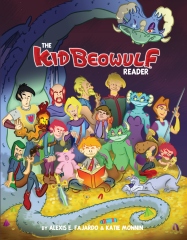
While assembling a list of Beowulf comics for another project, I initially skipped Alexis E. Fajardo's Kid Beowulf series on the grounds that it was not an adaptation of the original poem. While that characterization remains true, it was nevertheless a mistake to dismiss the book. Kid Beowulf is a well-written adventure comic with humor and a strong literary influence that makes it eminently suitable for middle-school readers. More advanced students will find Fajardo's progressive and sympathetic characterization of gender, faith, and culture to be rewarding and provocative. Moreover, a Reader's Guide with study questions, classroom assignments, and other teaching tools is now available, developed by Fajardo and Katie Monnin, a professor of literacy at the University of North Florida, whose outstanding credentials in this regard make her the ideal partner. All of this combines to make the book not only useful in the classroom, but a rarity in the comic marketplace: the sort of comic your daughter, niece or grand-daughter might enjoy.

The Kid Beowulf series is satisfyingly hefty; the three volumes published by Bowler Hat from 2008-2013 add up to 650 pages. In concept, the tale is essentially a prequel; years before their cataclysmic battle in Heorot, Beowulf and his twin brother Grendel are conceived, grow up, and are eventually exiled (Kid Beowulf and the Blood-Bound Oath), whereupon they begin a Heroic Journey through France (Kid Beowulf and the Song of Roland) and Spain (Kid Beowulf and the Rise of El Cid); they meet and adventure with a great many other heroes, including not just Roland and El Cid but Bradamant, Boudicea, and Ogier the Dane. Each book begins with a short 8-12 page adaptation of the source poem, but the rest of each volume is actually a complete re-imagining of the story of Beowulf, Roland and El Cid, virtually from the ground up. In France, for example, we find Ganelon in charge of the kingdom and slowly poisoning Charlemagne with daily doses of arsenic while he maintains Roland's loyalty by flattering his ego through the construction of a magnificent theme park entitled RO-LAND. The Peers are alive but in hiding, and Bradamant has been transplanted from Orlando Furioso to join the French Resistance training in the sewers. The two hundred pages in each volume are not padding or wasted space; there's a lot going on in these books.

Fajardo's influences are not difficult to identify, and he makes no secret of them. I was personally reminded of Matt Wagner's Mage II: The Hero Defined, a story in which King Arthur, Hercules, Prester John and other heroes rub shoulders and misadventures, but the most obvious is probably Asterix the Gaul, who -- along with his partner Obelisk -- even have surrogates in the book as Heathobard ne'er do wells out to murder Beowulf and Grendel to get in Froda's good graces. Literary sources include not only Beowulf, the Matter of France and El Cid, but also other literary works associated with these cultures. For example, Beowulf's mother is named Gertrude, his father appears to him as a ghost, and young Beowulf himself is exiled from the country. Orlando Furioso has already been mentioned, but the footprints of the Three Musketeers in the second volume are everywhere, with Ganelon as Cardinal Richelieu, Turpin playing the role of Athos, and Ogier the Dane as the love-lost Aramis. The fact that Ogier's paramour is a gypsy might be just a curious fact were in not for the presence in the story of a hunchback and repeated use of Notre Dame cathedral. The revolution against Ganelon is both a French Revolution and a French Resistance. A subplot in which Grendel (in a clown suit) and Beowulf (in a dress, playing the girl's part) are forced to perform on stage for money even provides an opening for a discussion of Renaissance theatrical practices. After all this, I was actually a little disappointed when I got to the El Cid chapter and Don Quixote did not appear.

After all of this, it can be difficult to write about the art on Kid Beowulf. Fajardo is entirely self-taught; he began with comic strips for his college paper and Kid Beowulf went through two previous versions before being entirely re-written and drawn for the editions from Bowler Hat. The most common adjective used to describe the style of Kid Beowulf is "cartoony," which is true as far as it goes, but which doesn't really say much. Fajardo's character designs are very strong and his technical skill improves throughout the series. The art excels at physical comedy and Fajardo has a great sense of timing. Many pages, however, seem rushed. When characters engage in conversation, or when an action scene arrives, backgrounds often entirely disappear and we are left with characters speaking, fighting, or leaping through a rootless empty space. Sometimes there is an effort to mask this with shades of grayscale, but because this shading is so obviously artificial, it does nothing to truly alleviate the problem and, in fact, contrasts painfully with Fajardo’s line work, making the situation even worse. Composing, drawing, and revising 650 pages is a monumental task which I can only appreciate, but Kid Beowulf and his brother Grendel would be better served if they moved through a world which was more reliably drawn and more carefully shaded.

Fajardo can do this; his work is full of panels and pages which are beautiful and dramatic. He cites Jeff Smith's Bone as one of his influences, and he could not ask for a better teacher. While I am sure there are panels and pages where Smith has scrimped in his portrayal of scene or background, such panels are hard to find. Even when Smith creates a background without line work, his use of color nevertheless creates trees, snow and sky. Look, too, to Herge's legendary background work in Tintin. McCloud's analysis of "cartoony" art styles and their relationship to realism is worth remembering here; like Bone and Tintin, Kid Beowulf is a book whose protagonists are made with open lines, curves, and a lack of realistic detail, empowering readers to project themselves in and don the character as a mask. This is very effective, but it is only half the equation. The physical detail of the world around those characters, in contrast, is not "cartoony," but physically real and sensually stimulating. McCloud calls this "one set of lines to see, another set of lines to be,"1 and, when Fajardo does it, such as in Ogier's trek from Spain back to Geatland, it works. He just needs to do it more often.

Selection from Kid Beowulf and the Rise of El Cid
One of the challenges to reading Beowulf is that it is a poem written for warrior men; half my class begins the project from a position of exclusion. This is not true of Kid Beowulf; Beowulf may not pass the Bechdel test, but Kid Beowulf does. The women of this book, most especially Gertrude (daughter of the Dragon and mother to our protagonists) and Bradamant, are fully realized characters with personal goals and the wherewithal to accomplish them. Non-entities like Roland's beloved Aude are simply deleted, replaced by more active heroines. They are still outnumbered by the men who surround them, but they are both variable and complex; no single broad brush encompasses them all. Ximena, the Cid's former-lover-now-hated-enemy, for example, finds herself trapped between youthful affection and the pain caused by the death of her father; when she seeks help, she gets it not from men, but from Urraca, the Queen of Leon. And although the story resolves in a triumph for Rodrigo, Ximena remains conflicted. This scene, and others like it, create an opportunity for us and our students to examine ourselves in a “What would you do?” moment that suddenly makes a tale centuries old alive and present. This is what medievalism can do in its best moments.

The same attention to characterization is present when Beowulf and Grendel travel among French and Spaniards, meeting Muslims, Jews, and even followers of Mithras, all of whom are presented fairly and with sympathy. The Song of Roland is an especially problematic text when it comes to the depiction of faith; having once attempted to write a film adaptation of it, I find it almost impossible to discuss without apologizing. But as Fajardo works through both the second and third volumes, his precedent for throwing out whatever does not suit his purpose, and mixing in whatever does, allows him to present a tale in which the characters are sympathetic human beings, not monstered others. The Muslim characters in this book refer to God frequently, but always as God, not Allah; this alone is going to be enough to prompt class discussion, especially if your classes happen to be located, as mine are, in the rural South. Some Christians seek war, while some Muslims seek peace, and the opposite is also true. No one culture or faith is entirely sympathetic or entirely alien. It would have been easy, in a comics marketplace home to Frank Miller's Holy Terror, in a country awash in post-9/11 "culture war" language, to portray the Muslims of Grenada, Cordoba and Toledo as wicked barbarians. That this is not done is Kid Beowulf's greatest strength, and the portrayal of culture, gender, and faith makes Kid Beowulf a useful read even for advanced students.

Finally, it worth taking a little time to talk about the future of Kid Beowulf. The draft of the Reader’s Guide that I had a chance to see provided valuable and entertaining insight into the origin of the book, its characters, and Fajardo's creative process. It is intended to be used with the Common Core and is marked for grades 6-12. It's not fair to judge a draft, and so I will not attempt it; I will note that the Guide includes lists of literary sources which went into each volume. While these sources include, for example, Heaney's translation of Beowulf and Gareth Hinds' masterful adaptation into the comics form, I would like to see the addition of other literature which is less directly referenced. For example, since the use of Hamlet is undeniable in the book, why can't we include that play, along with Three Musketeers and Hunchback of Notre Dame in the resources for Kid Beowulf and the Song of Roland? If one of Kid Beowulf's charms is that it functions as "gateway literature," then surely we should open that gate as wide as possible? As part of this move into middle school and high school classrooms, Kid Beowulf is also transitioning to an online webcomic, and Fajardo is taking this opportunity to add color to all 650 pages. This effort, which no doubt requires enormous work, is to be applauded. Other comics creators, like Eric Shanower, creator of the amazing Age of Bronze, have demonstrated just how laborious and slow this process can be, even when the rewards are great. It is my hope that Fajardo is able to follow through on this move to an online color webcomic, and perhaps take the opportunity to address some of the background and shading challenges which occasionally plague the book.

In the meantime, the print editions of Kid Beowulf remain a fun, engaging, and thought-provoking experience which rewards the close read.

*On November 5, 2013, the Kid Beowulf series was relaunched as a full-color webcomic. It will update twice a week beginning with book one. Previews are running on Tapastic, the site which will feature the webcomic, and can be viewed here: http://tapastic.com/series/Blood-Bound-Oath

Jason Tondro
College of Coastal Georgia


[ 1 ] See the second chapter of Understanding Comics for this discussion; McCloud’s use of Tintin as an example of “one set of lines to see, another set of lines to be” is on page 43.

November 14, 2013

Riley-Smith: The Crusades, Christianity, and Islam

Jonathan Riley-Smith, The Crusades, Christianity, and Islam. New York: Columbia University Press, 2011.

Reviewed by: Helen J. Nicholson (nicholsonhj@cardiff.ac.uk)

This volume contains a slightly revised edition of the Bampton Lectures in America that Jonathan Riley-Smith presented at Columbia University in 2007. The material draws together and builds on research and discussion which Professor Riley-Smith has published separately elsewhere. It provides a useful summary of his views on the nature of medieval crusading, but also continues the history of the movement into modern times. Riley-Smith shows how the concept of crusading and particularly of the military-religious orders was used as an instrument of imperialism during the nineteenth century and into the early twentieth, a phenomenon which he calls paracrusading (including some elements of the medieval crusade) or pseudocrusading (using crusade imagery and rhetoric, but with no other connection to the original crusades). The final chapter discusses how the modern view of crusading held by radical Islam developed from the nineteenth-century European fascination with crusading.

In this volume, Professor Riley-Smith has distilled cutting-edge historical research into an accessible short guide to the concept and reality of crusading over several centuries, fully supported by references to his sources and a full bibliography. Readers will not find a discussion of the debates between scholars of the crusades, but they will find a wide-ranging picture of crusading as a vibrant, growing area of research. The introduction surveys modern attitudes to crusading, especially those of the Greek Church, the Jews, and the Protestant and Catholic Churches. Chapter one considers the Christian ideology which underlay crusading, and argues that modern society cannot understand Augustinian just war theory because Augustine of Hippo saw violence as morally neutral, whereas modern just war theory regards violence as intrinsically evil. Riley-Smith admits that the seeds of the change in emphasis originated in the Middle Ages, but considers that what is now the dominant viewpoint did not become generally accepted until the nineteenth century. He goes on to discuss the crusades as holy wars and the motivations of crusaders, including the origins of the military religious orders as hospitaller organisations which became militarized in the course of their care for poor pilgrims. Chapter two considers crusades as Christian penitential wars, including a survey of crusade preaching.

So far, much of this material is familiar ground. Chapter three moves into less familiar territory, considering the revival of the concept of crusading and of the military religious orders in the nineteenth century. Riley-Smith considers several nineteenth-century schemes to re-establish or found new military-religious orders to defend and promote Christians or, more specifically, Catholic missionary work, in addition to calls for military expeditions which would emulate the medieval crusades. This discussion raises the question of when crusading came to an end – did it last until 1892, when plans for a new military-religious order collapsed? Considering this question, Riley-Smith concludes that these initiatives were in fact stimulated by modern imperialism rather than the old crusading motivations.

The final chapter considers the origins and development of modern radical Islam’s view of crusading. Starting from Kaiser Wilhelm II of Germany’s expedition to Jerusalem in 1898, organized by Thomas Cook, Riley-Smith points out that nineteenth-century western glorification of crusading, especially of the Muslim military leader Saladin, led to Muslim commentators taking up the subject, which had previously been largely overlooked in Muslim historiography. He argues that western commentators are unable to supply an effective answer to Islamic radicalism because they no longer understand crusade ideals. In Riley-Smith’s opinion, these ideals were largely abandoned in the West after the First World War, although they did appear during the Spanish Civil War and were occasionally referred to during the Second World War. Of course references to holy war continue into the modern day, in relation to ‘the Troubles’ in Northern Ireland or even in political debates in the US Congress; but they are largely unfamiliar in modern, secularized Britain.

Riley-Smith argues that the modern popular view of the crusades, both in the West and in Islam, ‘has more to do with nineteenth-century European imperialism than with actuality.’ It is impossible, he argues, to understand modern ‘religio-political hostility’ between westernized and Islamic societies, ‘erupting in acts of extreme violence’, unless we are prepared to face up to this fact (p. 79). While agreeing that modern popular views of the crusades are largely based on nineteenth-century nationalist myth, this reviewer would suggest that there are broader, underlying causes which lead modern Islamic radicals to turn to this stereotype. Crusade scholars may demonstrate that the stereotype does not reflect historical reality, but this will not remove the fundamental causes of radicalism, only the rhetoric used to promote it. That aside, in setting out to ‘place the Crusades in Christian history and to understand the long-term effects in the West and among Muslims of the use, and misuse of crusade ideas and images’ (p. 6), Riley-Smith has produced a valuable short guide to the crusade movement in both the past and modern times.

Riley-Smith concludes by reminding his readers that even modern secular societies can produce ideological violence. Modern wars might be fought in the name of anti-colonialism, humanitarianism or liberal democracy, but these are still wars fought for a ‘cultural or even pseudoscientific ideal that is considered by its adherents to be of universal importance’. So may modern wars be crusades under a different guise? This book will not only provide a stimulating read for those exploring the concept and history of crusading, but will help to prompt debate in the classroom on the motivation and purpose of war.

Helen Nicholson
Cardiff University