An Open Access Review Journal Encouraging Critical Engagement with the Continuing Process of Inventing the Middle Ages

October 25, 2013

Khanna: How the Run the World? Charting a Course to the Next Renaissance


Khanna, Parag. How to Run the World? Charting a Course to the Next Renaissance. New York: Random House, 2011.

Reviewed by: Aurélie Lacassagne (alacassagne@laurentian.ca)

If there is one thing this book has in common with medieval times, it is the rather complex and uncertain nature of its goals. If one were to try to map out the ideas defended in Khanna’s book, it would indeed look like a map of medieval Europe, with the constant changes of borders. Indeed, three tensions or ambivalences emerge from the reading contextualized in its relations to medievalism. Sometimes, the author asserts that our current world is neo-medieval; sometimes, he seems to wish this world would enter into neo-medievalism in order to be able to jump into a new Renaissance; and finally, the author often thinks as a medieval thinker, with the same categories and thought processes. These discursive tensions leave the reader with a long series of antithetical statements and prophecies. This substantive matter is probably not helped by the form itself. So we are faced with four problems that I wish to discuss in the following sections.

On the form
This form of writing, a hybrid of scientific literature and vulgarization literature, tends to make many readers uncomfortable. But as this type of book invades the shelves of the Starbucks of this world and is slowly but surely replacing academic books, it is even more important to pay attention to them. Parag Khanna is a thinker as well as a practitioner of international relations (or global politics as he would rather prefer). Considering his academic background, there is no doubt that he could have more systematically used numerous international politics theories in order to back a discussion on neo-medievalism. The works of English School thinkers such as Hedley Bull[1] who was the first one to introduce and discuss neo-medievalism in IR literature come to mind. Such theoretical insights would not have infringed on the will and effort of vulgarization. Vulgarization of scientific knowledge is the most difficult task, and thinkers in medieval studies probably know this more than anyone. How can we make our discourse intelligible while avoiding the trap of gross generalizations, approximation, preconceived ideas, and ready-made solutions? For medievalism studies, it requires first and foremost a deconstruction of popular beliefs such as the Middle Ages as a Dark Age[2]. Yet, P. Khanna almost starts with this very idea of “Europe’s darkest period” (p. 11). Vulgarization is tough to achieve, so somehow it is OK to fail. But more problematically, the form chosen seems to serve a hidden agenda: promoting an ideology advancing that states are inherently bad and inefficient; and that, of course, individuals and private companies are the solutions. Every piece of this book advances the same motto that only a public-private partnership can solve all global problems, from poverty and hunger to climate change and wars. Interestingly in the context of medievalism, although what constitutes the “public” is not explicitly mentioned, for the author, it is not the state (as commonly thought) but individuals (rich and/or famous) or groups of individuals (NGOs, civil society groups, religious groups) who constitute the “public”. That peculiar conception of the “public” seems very feudal indeed. This leads us to the second problem identified: medieval thinking.

Medieval thinking
Maybe I need to assert here that using the phrase “medieval thinking” does not imply from me a value judgment; it is not used pejoratively. It refers to the fact that P. Khanna uses categories or ways of thinking that predominantly belong to medieval thought. I will underline briefly several “medieval” ideas portrayed in this book. Of course, these ideas have existed – and survived – the Middle Ages, but they are emblematic of this period.

Firstly, he clearly has a Manichean view of the world, the “civilized” and the “barbaric”. So for instance, Khanna does not hesitate to write statements such as “We shouldn’t need tribunals to tell who the bad guys are.” (p. 99); and few lines later, “Leaders can quite easily be sorted out between those who are civilized and those who are barbarian.” (p. 100). But this dichotomized worldview is reinforced by a critique of legality.

Indeed, secondly, he does not believe in law, but in morality. “Which countries deserve a crippling blockade to isolate their rogue regimes and which leaders deserve to be assassinated? The question comes down to whether behavior change is sufficient or regime change is necessary” (p. 100-1). It is as if Grotius never existed; as if the whole idea and efforts deployed to develop international law in the last decades (but in fact, centuries, back to Grotius) did not exist. Some deserve to be killed, not trialed and judged. Consistent with this approach, P. Khanna presents a strong defense of terrorism which for him is “a dirty business, but [it] is very much a business” and “if used cleverly, it is undeniable that terrorism works” (p. 109). In fact, the author conceptualizes clearly that law is a hurdle and that politics is about morality. “International terrorist groups by definition violate state sovereignty, so violating it further to catch them should hardly be illegal” (p. 110). Readers will then be unsurprised when reading Khanna’s biography to learn that he served in 2007 as an adviser to U.S. Special Operations Command. And just to make things perfectly clear that law is a bad thing and morality a good one, this morality is based on, inspired by, nobody else than God. “But until popular uprisings can overcome police states and cults of personality, progressive interventionists will have to continue to be guileful, and even play God, in the name of saving people from their leaders” (p. 101).

Third, P. Khanna does not believe in democracy. And indeed, this was hardly a medieval concept. So he does not hesitate to defend the dictators of this world as long as they act and do things that democracies apparently fail to do. “There is no Thomas Jefferson in Africa, but at least President Paul Kagame of Rwanda, who rigs elections and marginalizes opposition, also builds roads and boosts education” (p. 139). (Needless to remind the readers that the same arguments have been used about Hitler, who exterminated opposition among many others, and also built roads, planes, tanks, thus reducing unemployment; and that that type of discourse is, in some countries, considered as crimes). Khanna’s priority –and that should be the world’s priority obviously - is business not democracy: “Today’s world features competing political and economic models, and the attractiveness of one over another is judged by the ability to provide material benefits for the people – not on how democratic it is” (p. 122).

Fourth, consistent with the ideas above, what really matters is survival. “There are an estimated one billion urban squatters, twenty-seven million slaves, and two billion small farmers; the only question we should be asking is this: Who needs what to survive without excessive dependence on others? Extending opportunities – not sexed-up campaigns to “make poverty history” – is the right and realistic way to improve lives” (p. 159). On two grounds this sentence illustrates medieval thinking. Firstly, the goal of the social relations we are embedded in is to survive, like in the state of nature described by Hobbes in which a man is a wolf to man[3]. There is no question of thinking about humanity as flourishing; but just surviving. Secondly, he knows the right way. This is a phrase that comes back often through the book; it is the right way. Medieval kings, princes and churchmen knew what was right; they had the right God, so the divine right to decide what was right

Thus, medievalism pervades Khanna’s way of thinking, quite clearly. What is rather unclear is located in his description of the current world: Is our contemporary world neo-medieval or should we aspire to make it neo-medieval?

Is it or should it be?
The author seems to constantly oscillate between a state of things and a sort of aspiration. We do not know really, although we can presuppose that he aspires to create a neo-medieval world, the necessary steps to think about bringing the world to a new renaissance period, as announced in the book’s subtitle and explained in the last chapter of the book. The author starts by asserting “our emerging reality: a new Middle Ages” (p. 11). Throughout the chapters, he draws parallels between the Middle Ages and today’s world. So, he highlights the importance of the cities, their political and economic role (p. 14), the overlapping identities, the resurgence of religious loyalties, the re-emergence of private militaries (i.e. mercenaries), the fear of the future and its corollary the beliefs in rather esoteric ideas, and what he calls the “symptoms of medievalism: economic chaos, social unrest, depraved morals, wild expenditures, debauchery, and religious hysteria” (p. 19). These discourses and parallels are quite well-known. They have been circulating increasingly in the last couple of decades; and actually periodically through the last few centuries. These discourses rely on specific myths about the Middle Ages. As any other myths, they perform a specific function: The mirror, the Other, through which we think of ourselves. As we know thanks to the works of Said and postcolonial thinkers, the Oriental Other has functioned as a way to define the Western identity. This Oriental Other was at the same time a space, a society and people (embodied in specific characters in some cases like Scheherazade for the Oriental Woman, while the “Turks” or the “Arabs” were a mass of barbarian males craving for blood and sex). But I think that the Middle Ages serve as an historical Other. In times of turbulence and uncertainties (and undoubtedly we live in such times, I agree with Khanna on this), we tend to use the medieval period as an historical Other, sometimes as a warning, sometimes as an aspiration. The author’s description of our world as being neo-medieval does not pass the rigorousness of history, and maybe that does not matter. What is interesting – or rather striking – is the appeal it has on the author. Khanna strongly believe that law is an obstacle, but also that the state – and the whole states’ system based on the preeminence of territorial sovereignty – is an obstacle; something obsolete, useless, that we should get rid of. So in these circumstances, the Middle Ages are appealing, because they represent a pre-Westphalian world. As mentioned above, Khanna strongly argues for public-private partnerships; partnerships between individuals, interest groups and companies. The solution to war is a partnership between companies of mercenaries and NGOs (a wee bit like in the Middle Ages, the NGOs replacing the Church). (See for instance p. 93 and p. 104). The solution to development (including poverty, hunger, etc.) is public-private partnerships, what he calls the forces of “new colonialism”; but of course a “good” new colonialism, not a bad one like the old colonialism because “the new colonialism isn’t intentionally exploitative, condescending, or coercive – only unintentionally so” (p. 97). Throughout the book, he lists all these great successes of private companies (including the controversial ones like Blackwater, Monsanto, Brazilian Vale, etc.) working together with NGOs and communities to do “real stuff” the “right way”. The examples given of such partnerships are just too numerous to quote, and of course, there are successes; they achieve a goal where sovereign states and international organizations like U.N. agencies (because of the states) have been failing for so long. But then, at the end, it all becomes blurry. After a whole demonstration of the goods of an Hobbesian world (the Middle Ages), of the wrongs of a Grotian or Lockean world (the Westphalian state system) and a disbelief in a possible Kantian world (“vague notions of global democracy are not the solution to our problems” (p. 25); equality is impossible (p. 158); a defense of relativism contra democracy (pp. 122-23)), he proposes in his last chapter the European Union as the model for the future of the world. But clearly, what the EU is about is to build a Kantian culture of anarchy[4]. He asserts that contemporary Europe is a “neo-medieval universe of linked but autonomous communities”…somehow like in the Middle Ages and that this is the very condition of peace. Only there are two problems with these assertions. First, despite some attempts at destroying the European states, they still continue to exist, and what the EU is today is a Europe of States; is in many respects what Kant has envisioned as a republic or federation of states[5]. European states have created the EU and are still its central actors. Ultimately, if the European states disappear, they would be replaced by a true European state acting as a territorial sovereign entity. What Europe is doing is continuing the historical process of territorial concentration that started in the late Middle Ages. Second, a medieval-like myriad of tiny little communities does not guarantee peace. The Middle Ages saw many wars and violence even if it was not as violent as usually thought. So far as we can see through history and despite returns, pauses and decivilizing processes, the direction of human history has been toward a great integration of territorial units going with an increased differentiation of function and growing relations of interdependencies as Norbert Elias brilliantly showed in his masterpiece on the process of state formation in England and France[6].

To conclude, Khanna’s reconfiguration of the world (by splitting states into smaller “autonomous communities”, by re-diffusing the use of force to companies and other private hands, and by making human survival dependent on the good will of private charity) seems medieval enough, but highly counter-intuitive to create the conditions of a perpetual peace, which, we assume, is the goal of P. Khanna, both as a thinker and practitioner of international politics. There exists a full-fledge paradox to think that coming back to medieval ways of living will ensure peace. It may ensure the survival of some; but is it all that we should hope for? P. Khanna mocks “books on global politics” arguing that the “world needs more rationality, creativity, common sense, generosity, kindness, cosmopolitanism, democracy, or humanism” (p. 208). Otherwise said, he mocks modernity, the Enlightenment(s?); but he does not try to think of a new modernity, not even of a postmodern, or postnational or post-state world that would have learned the lessons of the past. When H. Bull brought “neomedievalism”, he was keeping the idea of society and common good in his argumentation. Instead, P. Khanna bluntly argues for an ante-modern world, a return to the state of nature, a “societyless” state of nature. If he were only a thinker of international politics, it would not matter much, but as he is a practitioner, and adviser, an influential personality, this reading seemed very disturbing indeed.

Aurélie Lacassagne
Laurentian University    


[1] Hedley Bull, The Anarchical Society: A Study of Order in World Politics, London: Macmillan, 1977, pp. 254-55 and pp. 264-76.
[2] See for instance Charles Haskins, The Renaissance of the Twelfth Century, Cambridge: Harvard University Press, 1927; and in France, among many others, Régine Pernoud, Pour en finir avec le Moyen-Âge, Paris: Seuil, 1977.
[3] Homo homini lupus, Plautus.
[4] This terminology comes from Alexander Wendt, Social Theory of International Politics, Cambridge: Cambridge University Press, 1999, pp. 246-312. Wendt describes three types of cultures of anarchy: Hobbesian (based on enmity and thus self-help), Lockean (based on rivalry and the state’s right to exist and live but also conquer and dominate. This Lockean logic characterized the Westphalian state system), and Kantian (based on friendship; the recourse to violence in inter-state relations is not an option). He borrows this idea from Martin Wight (who was not talking of Lockean but Grotian), Martin Wight, “The Three traditions of International Theory”, in Gabriele Wight and Brian Porter (eds.), International Relations: The Three Traditions, Leicester: Leicester University Press, 1991, pp. 7-24.
[5] Kant has used the terminology of “Völkerrecht” because at that time and until the 1930s, the term law of nations of law of peoples was commonly used; but it has in fact always referred to states (thus “Staatenrecht”). But it is crystal clear at the reading of The Perpetual Peace that Kant thinks of a federation of states or a union of states. States are the actors of his proposal even if within the states, there must be a republican civil constitution (i.e. the citizens have to agree to go to war…). Immanuel Kant, Perpetual Peace, New York: Liberal Arts Press, 1957.
[6] Norbert Elias, On the Process of Civilisation, Dublin: University College of Dublin Press, 2012 (new and revised edition).


October 22, 2013

Kelen: Renaissance Retrospections

Kelen, Sarah A. (ed), Renaissance Retrospections: Tudor Views of the Middle Ages. Kalamazoo: Medieval Institute Publications, 2013. 


Reviewed by: Thomas Lawrence Long (thomas.l.long@uconn.edu

Perhaps because I have traversed three-score years in this vale of tears, with more of my own moyen age receding over my shoulder than lying ahead, I pause to recall how in my school days we configured periods of European history. In high school’s world history, it was the Greco-Roman Classical Age, a later rebirth of that in the Renaissance, and in between the Medieval. This latter was often elided with something called the “Dark Ages,” the ghost of William Camden (who is not mentioned in this otherwise fine book under review) whose early seventeenth-century Remains Concerning Britain offered “a taste of some middle age, which was so overcast with dark clouds, or rather thick fogs of ignorance, that every little spark of liberal Learning seemed wonderful” (p. 337). In college this schema, which had been canonized by Jules Michelet and Jacob Burkhardt in the nineteenth century and embedded in the curriculum in the twentieth century, was complicated by scholars who identified other prior renascences. As Erwin Panofsky wrote in 1944, “innumerable tendencies, ideas, inventions and discoveries credited to the Modern Era had announced themselves in the Middle Ages; . . . the Renaissance was connected with the Middle Ages by a thousand ties; and . . . the heritage of classical Antiquity had never been lost beyond recuperation” (pp. 201-202). Triumphalism surrendered to a new periodization: Early Modern (which sometimes included Late Medieval). In recent years we have not seen the demarcation between medieval and modern as clear or sharp. The launching of the Journal of Medieval and Early Modern Studies is one example of the ways in which new periodization has been institutionalized.

Editor Sarah A. Kelen has assembled eight thoughtful and well researched chapters, which she introduces in a chapter (“The Body and the Book”) that does more than summarize the scope and theme of the book, highlighting the collection’s preoccupation with images of both books and bodies. She begins with an allusion to the emerging field of adaptation theory but making an analogy between Hollywood’s appropriation of other media, on the one hand, and Chaucer’s borrowing of Petrarch, on the other. Analogously, how did early-modern Protestant authors appropriate medieval Catholic writers? The paradox as Kelen sees it is that “the ghost of the Middle Ages continued to haunt the early modern period because neither the tomb nor the text could wholly contain its occupants” (p. 1), which becomes particularly problematic when “the intertextual connections between early modern and medieval texts extend beyond literary fictions to historical, theological, and political writings” (p. 3). Here Kelen focuses her attention to the Tudor writing of history, where there was a keen awareness that the same medieval text might be used polemically to support opposing views. This emphasis agrees with F. J. Levy’s early insight and Jennifer Summit’s recent reformulation of the profoundly historicist character of the Tudor Reformation. Like the ruins of an abbey plundered for its worked stone to build a new Tudor edifice, early modern authors borrowed, sometimes quirkily, from medieval texts.

Body and book are much in evidence in Dan Breen’s chapter “The Resurrected Corpus: History and Reform in Bale’s Kyng Johan.” Breen observes that Bale’s play is not only the earliest extant play to represent kings but also one of the earliest to depict historians. The paradox of Bale’s play is formulated in the question: “what motive might a historian have to challenge a political dispensation that authorizes his work?” (p. 19). For Bale, the movement from manuscript to print culture enabled the publication of the documents of the English past (particularly after the dissolution of the monasteries) whose reading enabled members of the gentry (who could afford books) to “read English history . . . [in order] to learn one’s social role, and so by acting upon the principles gleaned from history study to make the shape of English society more coherent” (p. 22). Bale links “the act of memorialization” with “historiographical production” (p. 27) whose product is a reformed Church of England and a unified nation.

Kathy Cawsey’s “When Polemic Trumps Poetry: Buried Medieval Poem(s) in the Protestant Print I Playne Piers” turns to Tudor appropriation of the Piers Plowman tradition and conducts meticulous detective work. As she observes, other scholars have remarked offhand the presence of rhyme and alliteration in the prose polemic I Playne Piers, as though these features were no more than rhetorical decoration. Cawsey, however, performs a minute formal analysis and hunts down their exemplars or analogues. While concluding that I Playne Piers is “a messy patchwork of various sources” (p. 50), she also suggests that it “may mark a turning point in the printing of plowman texts, since [I Playne Piers’s compilers] . . . recognized the value of the form, not just the content, of medieval sources in arguing the case for the antiquity of Protestantism” (p. 51). In light of this observation, can we but think of Spenser’s poetics in the The Faerie Queene later in the Tudor period?

The Langland of Piers Plowman and a case of mistaken identity is the focus of Thomas A. Prendergast’s “The Work of Robert Langland.” The first to bring the poem to print, Robert Crowley, and then others in suit identified the poem’s author as “Robert” Langland, whom they characterized as one of Wyclif’s first followers, placing the poem not in a late medieval orthodox reformist tradition but in a heterodox line. Later modern critics have contended that Crowley and others invented Piers Plowman’s Lollard origins in order to make a case for Reformation antiquity. Prendergast rejects that conclusion and asserts, “the means by which the group of men discovered him were reflective of the humanistic methods of Erasmus, and involved the creation of a homosocial community that valued the sharing of intellectual work and the recovery of a rapidly disappearing past” (p. 71). Moreover, Prendergast observes that, after the death of Queen Mary and the accession of Queen Elizabeth, “the conditions under which antiquarians operated became more fraught, and something like borrowing a book, even a book with a good reformist pedigree like Piers Plowman, might indicate an unhealthy and dangerous interest in the past” (p. 86), given that England had already once relapsed into Catholicism.

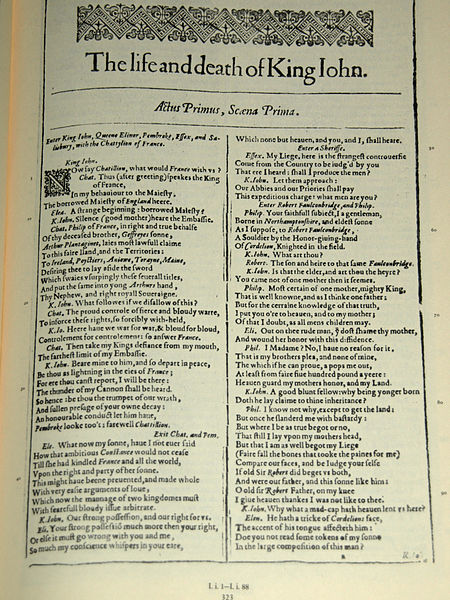
File:FirstFolioKingJohn.jpgJesse M Lander’s “The Monkish Middle Ages: Periodization and Polemic in Foxe’s Acts and Monuments” reminds us that the English Reformation historian owed more to Augustine, Bede, and Joachim for his taxonomy of history than he did to early-modern humanists. The Book of Martyrs “displays a particular sense of the Middle Ages that owes more to apocalyptic exegesis and anti-Catholic polemic than to humanist claims for the rebirth of the classical” (p. 95). The apocalyptically inclined Foxe had already inherited theologies of history, and, when he described the medieval period, he employed the figure of accumulatio, the congeries or heaping up of fables and superstitious rituals that accumulated during the Middle Ages. Regardless, Foxe always teased out signs of an underground True Church that never wholly left the Church of England even while it was under thrall to Rome.

Rome -- or at least Roman law -- is the polemical target examined in Rebecca J. Brackmann’s “‘That auntient authoritie’: Old English Laws in the Writings of William Lambarde.” At a time when their national church was struggling for legitimacy, the English also worked to establish the antiquity -- and the superiority -- of their laws and customs over foreign Continental impositions, with jurist William Lambarde as the paragon of this effort. In Lambarde’s analysis, English common law is understood as indigenous, and those who break it become foreigners, with any bad habits appropriated by the English seen as coming from outside. They are infection, and Lambarde developed a complex series of medical metaphors about the body politic, or as Brackmann observes: “law is no longer just the medicine by which the bad humors are purged, but instead has become the very soul of human society” (p. 123).

Bringing up the bodies and the law in the next chapter, “The Rebel Kiss: Jack Cade, Shakespeare, and the Chroniclers,” Kellie Robertson explores not only Shakespeare’s appropriation of the historical record of Cade’s 1450 rebellion (already a “cottage industry” in Shakespeare studies, Robertson allows) but also how the chronicles (Hall and Holinshed) themselves appropriated the historical events, particularly Cade’s supposed agitprop theatre of making the decapitated heads of his enemies kiss each other. She finds that “insofar as the act of historical writing reanimates dead bodies, the posthumous kiss in both chronicles and 2 Henry VI is essentially metahistorical, an emblem of the history tellers’ own larger project of refashioning the body politic” (p. 128). What she reads in Shakespeare’s play, then, has less to do with the playwright’s attitudes toward rebellion than with a larger anxiety about the theatrical representation of the dead.

William Kuskin’s “At Hector’s Tomb: Fifteenth-Century Literary History and Shakespeare’s Troilus and Cressida” offers a tightly argued, compound thesis: literary history must account for the complex relationships between rhetorical forms and their material production, that doing so discloses a persistent set of problems about authorship and form from the fifteenth to the seventeenth century, with attention to this complex relationship revealing “an alternative mode of reading literary history, one that describes not medieval otherness and early modern origins but the structural problems of representation implicit in vernacular literary production” (p. 146). What literary history acknowledges is the recursive power of the book, transcending literary history.

This rich volume concludes with “Owning the Middle Ages: History, Trauma, and English Identity” in which Nancy Bradley Warren examines anxieties about Tudor legitimacy represented in “female bodies and the roles those bodies play in legitimating or delegitimating dynastic lineages” (p. 174), which came to the fore during the reign of Elizabeth I. She argues for an unlikely source -- St. Birgitta and Brigittine spirituality -- to which the queen’s supporters, like John Foxe and Edmund Spenser, turned, particularly after the 1569 northern earls’ rebellion and Pope Paul V’s promulgation of the bull Regnans in Excelsis, declaring the queen to be a heretic and absolving the English of allegiance to her.

The book includes many useful visuals of medieval manuscripts and early-modern books, as well as a comprehensive bibliography of works cited in the chapters. With its wide scope, it will find readers among students and scholars of literature and history.

In bringing together these chapters into one body of work, Kelen proposes that there is “great scholarly potential that early modern medievalism still holds” since “[f]ar from being a buried past, irrelevant to later periods, the literature, historiography, politics, religion and law of the Middle Ages remained deeply bound up with some very contemporary concerns of the Tudor era” (p. 12). In recent years, this harvest has included such diverse work as David Gaimster and Roberta Gilchrist’s The Archaeology of Reformation 1480 - 1580, Fiona Somerset and Nicholas Watson’s The Vulgar Tongue: Medieval and Postmedieval Vernacularity, Ruth Morse, Helen Cooper and Peter Holland’s Medieval Shakespeare: Pasts and Presents, and Clare Costley King’oo’s Miserere Mei: The Penitential Psalms in Late Medieval and Early Modern England. It seems that we’re all post-medieval now.

Works Cited
Camden, William. Remains Concerning Britain. London: John Russell Smith, 1870.
Gaimster, David, and Roberta Gilchrist, eds. The Archaeology of Reformation 1480-1580. Leeds, UK: Maney, 2003.
Levy, F. J. Tudor Historical Thought. San Marino, CA: Huntington Library, 1967.
King’oo, Clare Costley. Miserere Mei: The Penitential Psalms in Late Medieval and Early Modern England. Notre Dame, IN: University of Notre Dame Press, 2012.
Morse, Ruth, Helen Cooper, and Peter Holland, eds. Medieval Shakespeare: Pasts and Present. Cambridge: Cambridge University Press, 2013.
Panofsky, Erwin. “Renaissance and Renascences.” The Kenyon Review, 6.2 (Spring 1944): 201-236.
Somerset, Fiona, and Nicholas Watson, ed. The Vulgar Tongue: Medieval and Postmedieval Vernacularity.  University Park, PA: Penn State University Press, 2003.
Summit, Jennifer. Memory’s Library: Medieval Books on Early Modern England. Chicago: University of Chicago Press, 2008.

Thomas Lawrence Long
University of Connecticut 

October 11, 2013

Hudson: Studies in the Medieval Atlantic


Hudson, Benjamin, ed. Studies in the Medieval Atlantic. New York: Palgrave Macmillan, 2012. 

Reviewed by: Jana K. Schulman (jana.schulman@wmich.edu)

This collection of seven essays originated at a conference, Sailing the Western Sea: The Atlantic Ocean in a Medieval Perspective, held in March 2009.  The volume’s purpose is to draw attention to the Atlantic Ocean, in all its vastness, and its impact on those who lived along it.  Hudson, in his Prologue, sets the context for the essays that follow, tracing references to the Atlantic from the earliest times, specifically those that highlight the distances and the interconnectivity, by means of travel, of those sailing it.  In the next four sections, he discusses the coming of Christianity and how it brought more deep sea navigation as saints and missionaries traveled by sea; the Vikings and their mastery of the sea; how the ocean contributed to trade and commerce; and, finally, how the Atlantic led to conquest, colonization, and subsequent support of commerce.   What is unusual about Hudson’s Prologue is that he does not discuss the seven essays at all, which is both good and bad.  The good is that the focus stays on the ocean itself, the bad is that there is no attempt to explain how the essays relate to each other; as someone whose field is more literary than historical, more focused, perhaps on Anglo-Saxon England and medieval Iceland, I would have liked an expert’s introduction that not only established the importance of the medieval Atlantic, but also explained the relevance of and connections between the seven essays.

Part I, Transnationalism and Environment, includes three essays: Alfred Siewers’s “Desert Islands: Europe’s Atlantic Archipelago as Ascetic Landscape”; Vicki Szabo’s “Subsistence Whaling and the Norse Diaspora: Norsemen, Basques, and Whale Use in the Western North Atlantic, ca. AD 900-1640”; and Thomas Haine’s “Greenland Norse Knowledge of the North Atlantic Environment.”  All three of these essays actually focus on the environment, but it is not obvious to this reader how any of them relate to the first word of the section heading, Transnationalism.

Siewer’s essay is very theoretical, and is also philosophical in tone.  Siewers, who has written on the environment and on ecocritical approaches to literature, argues that literature has an environmental function and that such literature is important because it illuminates the role the Atlantic played in the lives of the literature’s authors. The essay focuses mostly on early Irish literature, but Siewers also mentions Beowulf and frames the essay with reference to James Fenimore Cooper’s novel, The Deerslayer.  Siewers argues that the sea is both a connector and a divider, that it is otherworldly, particularly as articulated in early Irish literature, that it is more fluid than one would expect, and that close study of diverse, early texts informs us as to how to read the image of the sea.

Szabo’s essay is a fascinating analysis of how the Norse used and acquired whales.  She argues that, unlike the Basques who actively pursued whales and eventually developed a reputation for and a business of this, the Norse did not.  Instead, the Norse made use of whales only when they drifted ashore.  Consulting legal texts, sagas, and the archeological record, Szabo concludes that whales “were not the chosen food for the boldest Norsemen” (84); that people in Iceland were glad to have whale meat only in times of famine; and that a cultural reluctance or refusal to actually hunt whales might have contributed to the Norse extinction in Greenland. 

Haine’s essay examines what the Greenland Norse knew about the North Atlantic; focusing on oceanographic phenomena—such as the tides, non tidal ocean currents, surface water properties, and sea ice—and their relationship with and need for wood, he argues that they, because of their environment, had to know much about the sea, weather, and ice surrounding them. The section on wood is fascinating. Haine begins it by discussing what the Greenland Norse would need wood for (most necessary was good quality wood for building and repairing ships) and how they could obtain wood.  He identifies four sources of wood: native Greenlandic wood, which was inadequate for building large structures; imported Norwegian wood, which was a vital source; harvested timber from Markland, also a vital source; and driftwood, whose supply would vary from year to year.  The Greenland Norse, Haine concludes, would have paid close attention to ocean currents and sea ice as these would have an impact on the kind, amount, and quality of driftwood that came upon their shores. Unfortunately for the Greenland Norse, “these wood sources declined during the Norse Greenland occupation, especially toward the end” (115).

The second part of the volume, Colonialism, includes four essays: Christopher Fee’s “Med Lögum Skal Land Vort Byggja (with law shall the land be built): Law as a Defining Characteristic of Norse Society in Saga Conflicts and Assembly Sites throughout the Scandinavian North Atlantic”; R. Andrew McDonald’s “The Manx Sea Kings and the Western Oceans: The Late Norse Isle of Man in its Norse Atlantic Context, 1079-1265”; David Beougher’s “More Savage than the Sword: Logistics in the Medieval Atlantic Theatre of War”; and Kelly DeVries’s “Into the Atlantic or into the Mediterranean? Spanish Military Choices in the late Fifteenth and early Sixteenth Centuries.” The title of this part does not seem to be the best given the essays in the section; what is meant exactly by “colonialism”? Fee’s essay is not necessarily about taking over or settling a country, but about the importance of law as evidenced in place names. McDonald’s essay examines battles between the Manx and those peoples on neighboring islands among other things that set the Manx kings apart. Beougher’s essay focuses only on logistics, on how different countries organized and supplied their armies; at no point does he discuss anything to do with attempts to take control of another country.  Finally, DeVries’s essay is about colonizing the New World to some degree, but is more an analysis of why it took Spain so long to actually realize wealth from the New World.  The title of this section does not encompass the ideas or investigations of the essays contained within it.

In his essay, Fee investigates place names on the Isle of Man, Shetland, and Iceland, focusing specifically on the names Tynwald, Ting Wall Holm, and Thingvellir.  All three names contain the element “þing,” which in Old Norse-Icelandic refers to the parliament and the assembly site itself.  According to Fee, the fact that all three islands have places that are physical monuments to assembly places in addition to the relevant place names provides evidence of the importance of a cultural self-identification as Norse as well as the importance of law throughout the Atlantic where the Norse settled. 

McDonald examines the position of the Isle of Man and the role of the Manx kings in the broader context of the North Atlantic world. Noting the strategic placement of Man, between Britain and Ireland, McDonald argues that it is not at all surprising that the Manx people were excellent sailors.  Much of the information about the Manx comes from a chronicle, the Chronica regum mannie et insularum or Manx Chronicle. From this, we learn that the ruling dynasty was founded by Guððr Crovan and that his descendants ruled until 1265.  We also learn that the Manx were well respected as sailors and warriors, often hired as mercenaries. McDonald’s essay establishes and stresses the connections that the Manx had with Norway, Shetland, the Orkneys, and the islands—Lewis and the Hebrides in particular—both in terms of trade networks and sea voyaging.

Beougher’s essay is absolutely fascinating.  In his examination of the logistics necessary to feed and provision armies, he focuses on four different military theatres (Carolingian, Scandinavian, Anglo-Saxon, and Irish), and three different aspects of logistics (assembly of troops, rations and what people ate, and transportation of those provisions). Beougher demonstrates that Charlemagne got around some problems of provisioning troops by requiring his men to appear with three months worth of food supplies (187).  He also analyzes what a daily ration would need to be (1-2 kilos of bread daily supplemented with meat and drink) and how many carts would be needed to transport all the food, clothing, tents, baggage, and equipment to prepare the food.  Given the magnitude of this undertaking, it is not at all surprising that having waterways to transport food and other provisions makes it easier. Iceland and England provide Beougher’s second and third logistical models, differing from the Carolingian and the Irish.  In Iceland, most battles were small and involved groups of men moving over the land, either with their own provisions or with access to supplies freely provided from others. Beougher cites Flosi’s gathering of men from his quarter in Iceland and their movement over land to attack Njal. In England, the Anglo-Saxons were involved primarily in coastal defense; the nobles came when called and farmers and workers supported them.  In Ireland, little information exists about how people moved about, but it is clear that people involved in battles relied on horses and cattle because they moved themselves (and thus the men had beef to eat). In other words, having cattle to eat made the lack of roads less of an issue.  All four of these models combine to demonstrate that extended fighting could not be sustained, with one exception, and that the kings and peoples of these four countries were well aware of how to work with what they had.

DeVries analyzes what Spain preoccupied itself with in the fifty years after Columbus died: the Spanish monarchs focused on their interests in the Mediterranean because these interests were known producers of wealth.  He argues that the New World needed to pay its way and that until this happened or was perceived to happen, Spain would invest its funds in known commodities (209).  For some sixty years, from 1494 to 1559, therefore, Spain was at war with France over holdings in Italy. According to DeVries, Italy was so much more important economically to Spain that Spain chose to ignore the threat of the Ottoman Empire; even though Columbus’s voyages were couched in the language of conversion, the Spanish did not pay attention to the Muslims.  Greed trumped spreading the Christian faith as a motivation to wage war (221). 

The volume, while a collection, lacks not only an introduction to the essays, but also standardization of spelling; it is truly as if each essay stands alone and no one has sought consistent spelling or proofread the essays.  There are typos in the prologue and most of the essays (I mention only a few: “upstream on even on minor rivers” p. 10; “for those who refuse to divided fairly” p. 69; “must have seem” p. 217).  Spelling of personal names and foreign words is inconsistent both within essays and between them. In Fee’s essay, he spells lögum in his essay’s title with an umlaut, but does not do so in any other words where one would expect that: lögberg, lögsögumaðr.  The absence of the appropriate diacritical marks is made more noticeable because the author of the next essay, McDonald, does not omit any of the special characters. Furthermore, Beougher mentions two of the same people that McDonald does, a certain Svein and Holdboldi, but spells one of their names differently from McDonald, who uses the Icelandic spelling (Sveinn).

Other inconsistencies and lack of proofreading abound.  In Fee’s essay, the quote from Njal’s saga has vort ‘our’, but the word has been translated as the definite article, ‘the’. Also, referring to Njal’s saga both as Njalssaga and Brennu-Njal is confusing for a reader not familiar with the Icelandic titles of the saga. In two quotations from an essay by Gillian Fellows-Jensen, Fee has introduced errors. In McDonald’s essay, there are fewer errors, but one particularly irritating error is a reference in note 14 to note 186 for a further discussion.  While I would have liked to read the promised discussion, there is no note 186. 

Further problems that may derive from the essay authors’ diverse backgrounds and/or from an audience that is never defined include a reference to Njal’s saga as an historical romance (Beougher, p. 189); Siewers’s contention that Beowulf’s fights with Grendel and his mother reflect “Anglo-Saxon colonialism” (37); and Haine’s figures that seek to provide information about the sea’s currents, temperature, and salinity.  What is Siewers’s evidence for Beowulf’s fights reflecting Anglo-Saxon colonialism?  Given that Grendel comes into Hrothgar’s hall, who is the colonizer? Speaking to the issue of saga-genre in Beougher's essay, Njal’s saga is not an historical romance; it is one of the sagas of Icelanders, which means that it has historical elements; it is never classified as one of the romances.  Finally, Haine’s figures, found in his essay’s first section, Norse Environmental Knowledge, indicate currents, temperatures, and salinity respectively, but these are very technical, hard to read, and there is little discussion of what the figures indicate and/or why they are relevant. While Haine is a professor of physical oceanography, as indicated in his contributor’s biography, he does not consider the fact that many of the book’s readers may not be.

Studies in the Medieval Atlantic does allow the reader to appreciate the Atlantic Ocean, its image, and its significance in the lives of those who lived on its shores. While I was extremely frustrated by the number of typos and errors in general—errors that could have been so easily caught and fixed—I enjoyed the essays and found myself thinking about the Atlantic Ocean in ways other than I have previously.

Jana K. Schulman
Western Michigan University